 |


|
 |
|
Doug Richardson
© «Flight International», 1976 Our address: en@rvsn.info |





See also: |
||||||||||||||||||||||||||||||||||||||||||||||||||||||||||||||||||||||||||||||||||||||||||||||||||||||||||||||||||||||||||||||||||||||||||||||||||||||||||||||||||||||||||||||||||||||||||||||||||


| ||
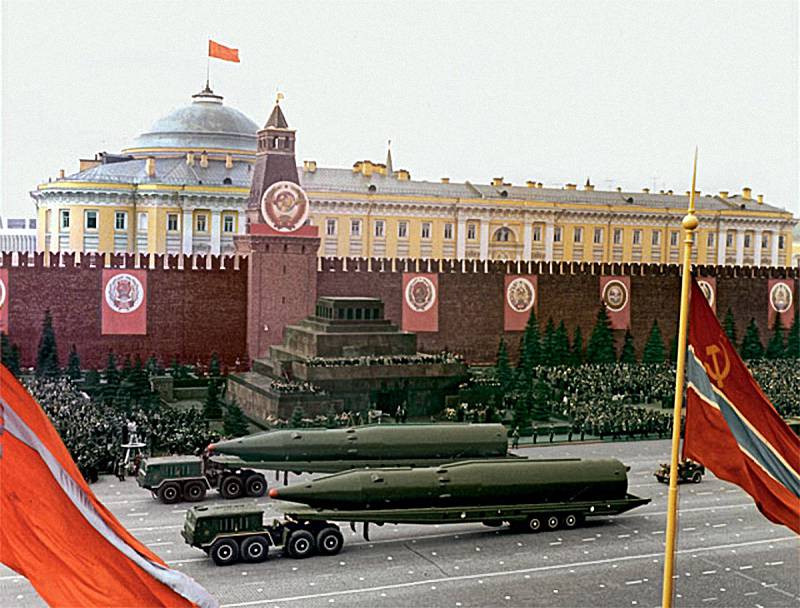
If the Raketnyye Voyska Strategicheskovo Naznacheniya (Russian Strategic Rocket Forces) is not the most powerful missile arm in existence, it must surely be the most security-conscious. Official pronouncements from Moscow about these forces and their weapons are few and not particularly enlightening to the student of missile technology. The blanket of security is lifted on a strategic weapon only if it is exhibited during a military parade or exercise, and no more than a few photographs showing test firings or operational units are ever released. If full security is maintained, a weapon can pass through development, enter service, remain deployed for a decade or more, and then be phased out as obsolescent without any official information being released by the Soviet authorities.
Most of the information available on the Russian strategic forces and their weapons has been gathered by the Western intelligence services and leaked, accidentally or otherwise, to the outside world. Not all of the subsequently published information is reliable. Some of the dimension data appearing in print are clearly suspect— the length/diameter ratios of the scale drawings produced from this information can look distinctly "wrong."
It is also possible that the US authorities may for political reasons choose to bias the data which they make available. In November 1974 at Vladivostok the Russians were prepared to accept the same ceiling as the USA on delivery-vehicle numbers. Two years earlier they had insisted on having a 3:2 lead in numbers of strategic missiles in order to offset the US lead in MIRV and guidance technology. If the Soviet Union now feels confident that her missile forces are equal in quality to those of the USA, the performance of the new third-generation missiles must be better than US sources tend to indicate.
Several improvements in Russian technology have been noted in recent years. The stellar-inertial guidance system used by the SS-N-8 SLBM is significantly more accurate than that of previous missiles. All the third-generation ICBMs—the SS-16, -17, -18 and -19—carry a post-boost vehicle embodying a digital computer which can be used to finely adjust the final warhead trajectory or to release MIRVs along separate flightpaths. The re-entry vehicles have a higher terminal speed than those fitted to the second-generation force. Present US warheads have high re-entry speed coefficients (also known as "Beta factor") giving terminal velocities of about Mach 10. This compares with the Mach 1 speed of second-generation Soviet warheads, which are therefore more vulnerable to the effects of wind and other meteorological factors.
ABBREVIATIONS CEP — circular error probability, ICBM — intercontinental ballistic missile, IRBM — intermediaterange ballistic missile, KT — kiloton, MT — megaton MIRV — multiple independently targeted re-entry vehicle, MRV — multiple re-entry vehicle, SLBM — sub-surface-launched ballistic missile. |
Flight tests of new, higher-Beta-factor re-entry vehicles — almost certainly fitted to the third-generation ICBM force—have been monitored by the US. Tests have also been observed of the first Russian manoeuvring re-entry vehicle (MARV), which is probably intended for use on fourth-generation ICBMs. Russian solid-propellant technology has been slow to develop but will be more widely used in this new range of missiles, which includes the first Russian solid-fuel SLBM. The existing missiles deployed aboard Yankee and Delta-class submarines all use storable liquid propellants.
The survey which follows describes all the missiles in the "SS-" classification. Some of these are obsolete and are no longer in service. Others are tactical in range but are included for the sake of completeness because they have been allocated a US designation in the SS series. In the data tables the dimensions quoted are believed to be correct to within plus or minus 10 per cent.
| ||
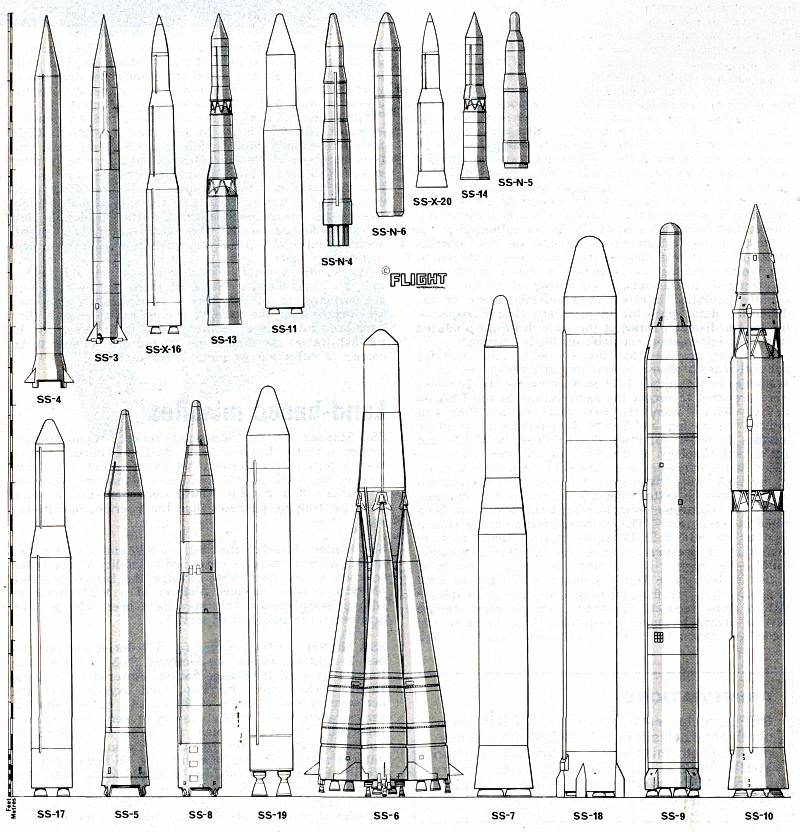
The entire range of first, second and thirdgeneration Russian long-range ballistic missiles is shown here to a common scale. Missiles shown in outline only have never been displayed to Western observers; the relevant drawings are based on a US Department of Defence diagram and a series of models by Boeing Aerospace
Land-based missiles
SS-l Scunner
The first long-range rocket weapon to enter service with the Russian Army, SS-l is believed to have been a copy of the German A-4 (V-2) rocket. The small number deployed in 1947, two years before the explosion of Russia's first nuclear bomb, were probably intended more for training purposes than for a serious operational role.
SS-2 Sibling
Based on the SS-l, the SS-2 embodied Russian modifications to increase range and reliability. Photographs released in the late 1950s showing the launch of "geophysical rockets" included pictures of a V-2-type rocket with extended tanks; this may have been Sibling. Like Scunner, it saw only limited service.
SS-3 Shyster
First displayed in 1957 during the November 7 military parade in Moscow, SS-3 was the first Russian-designed long-range rocket. Powered by a single RD-103 rocket motor burning liquid oxygen (lox) and kerosene, it had a range of 900km. An earlier, shorterrange version using alcohol instead of kerosene has been reported. This would explain the large variation in the published range figures for this weapon. Shyster first entered service in 1955, and like the SS-l and -2 was a mobile weapon launched from a simple firing table. Now withdrawn from service, SS-3 may be held in reserve as the Russians tend not to scrap a weapon as long as it remains of potential use. Guidance was by radio command, with aerodynamic surfaces on the fins and vanes in the motor exhaust providing control. Nuclear or high-explosive (HE) warheads could be carried.
SS-4 Sandal
A development of Shyster, the SS-4 was deployed as the standard IRBM from 1959 onwards and remains in service. Three metres longer than the SS-3 but retaining the same diameter, Sandal does not have the tapered nose section found on the earlier missile. A 1MT thermonuclear or a conventional HE warhead can be fitted. Early rounds used a command-guidance system similar to that of the Shyster, but a later version employed inertial guidance and was powered by storable (nitric acid/ kerosene) propellants rather than the original cryogenic lox/kerosene. The flared tail skirt houses a four-chambered RD-214 rocket engine giving a thrust of 72,000kg. In the mobile role, the complete weapon system consists of a convoy of about a dozen vehicles carrying ground-support equipment and propellants. A 20-man firing crew is required to erect and fuel the missile.
During 1962 a number of Sandals were installed in Cuba but withdrawn again as a result of US pressure. At present, 500 SS-4s are deployed in the Western USSR and along the Sino-Soviet border in Central Asia, some in silos. This force is expected to be replaced by SS-X-20s by the 1980s.
With an upper stage added, the SS-4 has been used as a launch vehicle for Cosmos satellites weighing up to 400kg. Known in the US as the B-1, this combination has flown from the Plesetsk and Kapustin Yar launch sites.
SS-5 Skean
A second, longer-range IRBM followed the SS-4 into service. Similar in length but greater in diameter than Sandal, Skean has no external controlling fins and relies on vanes acting on the motor exhaust. The guidance system is inertial, like that of all subsequent Russian long-range ballistic missiles. A four-chambered engine is used to power this single-stage missile, which has a range of 3,500km with a 1MT warhead. Skean entered service in 1961 and about 100 rounds are deployed in the Western USSR, some in silos but the majority at soft sites. Although launch sites for the SS-5 were under construction in Cuba during the 1962 crisis, there is no evidence that the missiles had arrived before the US blockade took effect.
Like the smaller SS-4, Skean has been modified for use as a satellite launch vehicle and has orbited payloads weighing up to 1,500kg. The launch vehicle has a restartable third stage and may be used to orbit military reconnaissance satellites from the Plesetsk launch site. In this form it is known as the C-l.
SS-6 Sapwood
Work on the first Russian ICBM began in the early 1950s. When Convair (now General Dynamics) first began to study the feasibility of a US ICBM in 1951, the size and weight of existing thermonuclear warheads dictated the use of a very large vehicle weighing more than 200 tons. Rather than go ahead with a weapon of such size, the US decided to wait until improved technology permitted a substantial reduction in the weight and dimensions of megaton-class warheads. The Russians, faced with similar problems, opted to continue development in order to field an ICBM force at the earliest possible date as a counter to the US manned bombers.
The resulting missile was test-flown for the first time on August 3, 1957, with the first full-range test following on August 27. Six weeks later it was used to launch Sputnik 1. A central core vehicle containing a four-chambered RD-107 engine of 96,000kg thrust is surrounded by four boosters each powered by a four-chambered RD-108 engine of 102,000kg thrust. With one or more upper stages added in place of a warhead, Sapwood has been used as a launch vehicle. The Sputnik, Luna, Vostok, Voskhod, Soyuz, Prognoz, Zond, Mars and Venera programmes have all relied on different versions of this launcher. US sources refer to these as the A-series launchers.
Progress with the SS-6 ICBM was slow. Difficulties with the electronic systems resulted in low reliability and poor accuracy—the CEP was probably about 8km. The use of lox/kerosene propellant in such large quantities resulted in a long reaction time, while the size of the missile dictated "soft" launch sites.
Only a small number of SS-6s were deployed as a nominal strategic force, probably as few as ten, and they were retired as soon as possible in the early 1960s.
SS-7 Saddler
The, first Russian ICBM to be deployed in large numbers, Saddler is a two-stage missile powered by storable liquid propellants. The mid-1950s breakthrough in nuclear technology greatly reduced the weight of thermonuclear weapons—the 5MT-yield SS-7 warhead is reported to weigh about 1,200kg. Despite its age and present obsolescence (it entered service 15 years ago), Saddler has never been displayed in any Red Square military parade. Two versions are known to exist, the original Mod 1/2 and a later Mod 3 which entered service in 1963. By 1967 a total of 200 were installed in hard and soft launch sites. Saddler is now being phased out and replaced by SLBMs. In May this year the US State Department confirmed reports that the dismantling of a number of installations, as required by the Salt agreement, had not taken place within the mandatory four months of service entry by the replacement SLBMs. By June, however, the dismantling had begun, and the SS-7 force is now approximately 90 strong. More accurate than the interim SS-6, Saddler has a CEP of less than 2km.
SS-8 Sasin
Probably intended as a back-up to the SS-7, Sasin is a two-stage ICBM similar in appearance to the SS-5 IRBM, and may use the same engine installation. About 200 of these missiles were deployed from 1963 onwards; they are now being withdrawn from service and replaced by the new SLBMs. Sasin, like the SS-7, has a 5MT 1,200kg warhead, uses storable liquid propellant, and has a 2km CEP.
SS-9 Scarp
First of the second-generation ICBMs to be deployed, Scarp is a heavy silo-based missile which first entered service in 1965. By 1970 the force was 288 missiles strong, remaining at this level until the second half of 1975, when some SS-9s were withdrawn from service to make way for the third-generation SS-18. At present about 210 remain in service.
The missile has been described by different sources as two or three-staged. The first stage is powered by a cluster of six engines, plus four vernier motors faired into the surrounding skirt. The guidance system is more accurate than that of the other second-generation ICBMs. The CEP is better than 1,5km and could be as low as 0,8km. Five versions of Scarp are known to exist
Mod 1 Single re-entry vehicle with large (approximately 20MT) warhead. In service since 1966, but few remain operational.
Mod 2 The most widely deployed variant has a single 25MT warhead.
Mod 3 Tested as a depressed-trajectory and Fractional Orbit Bombardment System (FOBS). In the former role excess energy from the booster permits a lower-angle trajectory than the minimum-energy flightpath, thus lowering the apogee and allowing the warhead to cover a greater distance before rising above the radar horizon of the target. In the FOBS role the warhead is placed in a low orbit around the Earth, decelerated as it approaches the target, and placed on a suitable trajectory to impact. The defending radar's warning time is greatly reduced and the attack can be mounted from any direction, but accuracy tends to suffer unless terminal guidance is used. Mod 3 was first tested in 1966 but no trials have been detected since August 1971. The US Department of Defence believes that this version of Scarp is not operational.
Mod 4 This version carries three MRVs and was first tested in 1969-70. The "footprint" of the three impact points is similar to the dispersal of a typical cluster of Minuteman silos. In 1973 further Mod 3 trials were conducted, perhaps as part of a MIRV development programme, but since then no further tests have been observed. The system is not thought to be operational.
Mod 5 SS-9 boosters carrying satellite-killing payloads have been launched from Tyuratam, and interceptions have been carried out against target satellites launched from Plesetsk. According to Aviation Week, SS-9 missiles have been wheeled from their hangars, erected at the launch pad, fuelled and launched on anti-satellite missions. This work was carried out to a schedule which on actual missions would result in a launch in less than 90min from the start of booster transport to the pad.
SS-10 Scrag
Developed in parallel with the SS-9, Scrag is not thought to be operational. The first stage was powered by four large rocket engines, probably the first Russian example of gimballed motors, while the second and third stages each had a single motor. Scrag is believed to have been the last Russian missile to use cryogenic propellants, and was less advanced in design than the SS-9.
SS-11 Sego
Thei most extensively deployed Soviet missile, the SS-11 has only been displayed within a cylindrical container 20m long and 3m in diameter. SS-11 is believed to be a two-stage liquid-propellant weapon with four firststage thrust chambers. Most sources claim that Sego is cold-launched from the silo, but the recent installation of SS-17 and -19 missiles in SS-11 silos suggests that hotlaunch techniques may be used (see SS-17 entry below). Three versions of the SS-11 are known to exist, but neither has a sufficient combination of accuracy and yield to be effective against hard targets such as Minuteman silos.
Mod 1 Most of the existing force is made up of this single-warhead variant; yield is reported to be I or 2MT, while the CEP is about l-5km. First deployed in 1966, this version makes up more than 85 per cent of the current force of more than 1,000 SS-lls. Between 1971 and 1975 a total of 970 rounds were in service, but this year has seen about 50 missiles'retired and replaced by the Mod 3. Others are being replaced by the SS-17 and -19. According to some reports, part of the force is used in the IRBM role, perhaps with a heavier warhead. The reduction in range would improve the CEP figure.
Mod 2 This version is reported to have had a more accurate re-entry vehicle incorporating countermeasures to aid penetration of an anti-ballistic missile system. There have been no test flights recently, suggesting that this programme has been terminated.
Mod 3 The first operational Russian missile to carry MRVs, each with a 300KT warhead, this version may also have a more accurate guidance system giving a CEP of less than 1km. More than 60 are now in service.
SS-12 Scaleboard
This tactical missile, which may be based on SS-14, is enclosed in a ribbed container carried by a MAZ-543 eight-wheeled vehicle. The container is lifted to the vertical and the container opened and moved aside before the missile is fired. SS-12 has never been shown to Western observers, but it is believed to be solid-fuelled, to use inertial guidance, and to have a range of 700-800km with a megaton-range warhead. The container is approximately 11m long and lm in diameter.
SS-13 Savage
The only solid-propellant Russian ICBM, Savage was developed in parallel with the SS-11. The project does not appear to have been very successful, several reports telling of technical difficulties with the guidance and propulsion systems. Savage entered service in 1968, and about 60 have been stationed in silos at Plesetsk since 1971. At 2km the CEP is poor, so reports that the force has been fitted with MRVs are unlikely to be correct.
SS-14 Scapegoat
This missile consists of the two upper stages of the SS-13 enclosed in a split container carried on a modified JSIII tank chassis. The system entered service the same year as the SS-13 and has the same poor accuracy. The method of operation is similar to that of the SS-12.
SS-15 Scrooge
The tracked vehicle on which the SS-14 is mounted carries a launch tube 19m long and 2-2m in diameter. This is elevated before firing, and the missile, which may be a modified SS-13, is launched directly from the tube. Scrooge units are believed to be deployed along the Sino-Soviet border in Outer Mongolia. Although first displayed in 1965, the SS-15 system may have entered service as late as 1970.
SS-X-16
A third-generation solid-propellant replacement for the SS-13, this missile can be deployed on mobile launchers or hot-launched from silos. First detected by US reconnaissance in 1972-73, it has twice the throw weight of the Savage and greater accuracy, and can carry either three MRVs or a single warhead of at least 1MT. Like all the third-generation ICBMs (SS-X-16, SS-17, -18 and -19) the final stage carries a post-boost vehicle with an on-board digital computer, enabling it to carry MIRVs. So far only MRVs have been flown on this missile. The weapon is not yet in service, but some US defence officials believe that it has been manufactured in quantity over the last year and stockpiled pending a deployment decision. The US objected during the Salt 1 talks to any deployment of land-based mobile ICBMs by the USSR, but has since unilaterally declared that such systems are acceptable provided no attempt is made to conceal the number in service. These objections are difficult to understand in view of the existence of the SS-15 mobile system.
| Desig- nation |
Dimensions | Throw weight (kg) |
Propulsion | Warhead | ||
| Length (m) |
Dia (m) |
Range (km) |
||||
| SS-3 Shyster |
21 | 1,7 | 700-900? | See text | Nuclear or HE | |
| SS-4 Sandal |
23,5 | 1,7 | 1,800 | See text | 1MT or HE | |
| SS-5 Skean |
24,5 | 2,6 | 3,500 | Storable liquid | 1MT | |
| SS-6 Sapwood |
30 | 8,5 | 8,000+ | Lox/kerosene | 5MT? | |
| SS-7 Saddler |
32,5 | 3,1 | 11,000 | 1,200 | Storable liquid | 5MT |
| SS-8 Sasin |
25,5 | 2,9 | 10,500 | 1,200 | Storable liquid | 5MT |
| SS-9 Scarp |
37 | 3,4 | 12,000 (Mods 1-3) |
5,000 | Storable liquid | Mod1,20MT |
| Mod 2, 25MT | ||||||
| Mod 3 ? | ||||||
| Mod 4, 3 MRVs | ||||||
| Mod 5 ? | ||||||
| SS-10 Scrag |
38,5 | 3,4 | 12,000 | Lox/kerosene | — | |
| SS-11 Sego |
19 | 2,4 | 10,000 | 700 | Storable liquid | Mod 1, 1-2MT |
| Mod 2, 1-2MT? | ||||||
| Mod 3, 3 MRVs | ||||||
| SS-12 Scaleboard |
11? | 800? | Solid? | 1MT? | ||
| SS-13 Savage |
20 | 2,0 | 8,000 | 500 | Solid | 1MT |
| SS-14 Scapegoat |
11 | 1,4 | 2,000? | Solid | 1MT | |
| SS-15 Scrooge |
18,5? | 2,0? | 5,600 | Solid? | 1MT? | |
| SS-16 | 20 | 2,1 | 9,000 | 900 | Solid | 1 MT or 3MRVs |
| SS-17 | 23 | 2,6 | 10,000 | 2,000 | Storable liquid | 4 MIRVs of 1MT each |
| SS-18 | 36 | 3,4 | 12,000 | 7,000 | Storable liquid | 50MT or 8MIRVs |
| SS-19 | 27 | 2,8 | 10,000 | 3,000 | Storable liquid | 6 MIRVs of 1MT each |
| SS-20 | 11? | 1,7? | 5,700 | 500 | Solid | 1-5MT or 3MRVs 50KT |
| 7,500 | 150 | |||||
| SS-N-4 Sark |
15 | 1,9 | 650 | Solid? | 1MT? | |
| SS-N-5 Serb |
10 | 1,7 | 1,300 | Storable liquid | 1MT? | |
| SS-N-6 Sawfly |
13 | 1,8 | 2,400 (Mod 1) |
Storable liquid | 1-2MT(Mods1 and 2) or 3 MRVs (Mod 3) |
|
| 3,000 (Mods 2 and 3) |
||||||
| SS-N-8 | 17? | 2,0? | 7,800 | Storable liquid | 1-2MT(Mod 1) | |
SS-17
A third-generation replacement for the SS-11 Sego, this is believed to be a two-stage hquid-propellant ICBM related in its technology to the earlier missile. Like the SS-18, it is designed to be cold-launched from the silo. SS-17 first flew in the second half of 1974 and has now entered service, 30 being installed in modified SS-11 silos. The fact that the new missile uses the silo of the earlier weapon may throw light on the SS-11 launch method. The SS-17 is reported to be 25 per cent longer than the -11. Cold-launch systems require very little clearance between the missile and the silo walls and floor. For a hot-launch system, however, the silo is typically two or three times the missile diameter and 50 per cent deeper than the missile height. It follows that an SS-11 silo should not be more than 21m deep if that missile is cold-launched. How then is the silo able to accommodate the 25m-long SS-17? Under the present US/ USSR understanding, the size of existing silos cannot be increased by more than 15 per cent. Either the SS-11 silo designer allowed surplus length for future developments, or the SS-11 is hot-launched from a 30m-deep silo.
All reports confirm that the SS-17 is a high-accuracy weapon with a CEP as small as 500m. Four MIRVs are carried, each with a 1MT warhead. SS-17 is believed to be more advanced in technology than the rival SS-19, but both are capable of attacking hard targets.
SS-18
This large liquid-propellant missile—the largest in the world—is comparable in accuracy to the SS-17 and is intended to replace the existing SS-9 force. The warhead/ accuracy combinations available from the three versions known to exist make this missile a potent weapon for use against the US Minuteman force, and a dangerously destabilising influence on the current strategic balance.
Mod 1 This version is now in service, carrying a single 25MT warhead.
Mod 2 Perhaps the most effective anti-silo variant, this carries eight MIRVs of 1-2MT yield each. It has not yet been deployed.
Mod 3 Not yet in service, this carries a single re-entry vehicle lighter and more accurate than that of the Mod 1.
SS-18 is now starting to replace the hot-launched SS-9. Being cold-launched, it requires less silo room than the -9, allowing additional steel and concrete to be applied to the silo to increase its resistance to nuclear attack. The type IIIZ silos currently used by the Russians as command and control facilities are large enough to house SS-18s and permit a swift increase in the numbers deployed. The Pentagon claims that only 30 IIIZ silos exist, and not 150 as had been reported earlier this year. According to the US magazine Air Force, the SS-18 has suffered persistent technical problems which have not yet been solved, despite the weapon's entry into service. This report has not however been confirmed so far by any other source. According to US Defence Secretary Rumsfeld, 40 of these missiles had been deployed by September this year.
SS-19
A back-up to the SS-17, this weapon is believed to embody less advanced technology than the latter, in spite of having a similar configuration. Nevertheless, the SS-19 has achieved a high success rate during trials. It was first tested in early 1974 and entered service a year later. More than 100 rounds have been deployed so far. Some reports claim that the weapon is being installed in modified SS-11 silos, but—as the -19 is hot-launched and would require a silo at least 40m deep—this seems unlikely. Either new silos are to be provided, or the US Department of Defence is mistaken in classing the SS-19 as hot-launched. The missile carries six MIRVs, each containing a 1MT warhead. Accuracy is probably similar to that of the SS-17.
SS-X-20
This variable-range missile uses the two upper stages of the solid-propellant SS-16 and will be deployed on mobile launchers in the same way as the SS-I4. Like all the third-generation missiles it has a post-boost vehicle and could carry MIRVs. SS-X-20 is not yet in service, but the trials programme on the Kamchatka Peninsula is almost complete. Three versions are believed to exist but the Mod numbers are not available; all employ the same basic missile:
(a) A 5,700km-range IRBM with a 1-5MT warhead.
(b) A similar missile carrying an alternative payload of three MRVs.
(c) A 7,500km-range ICBM carrying a lightweight warhead weighing about 150kg and having a yield of at least 50KT.
An ability to vary range by substituting the lightweight ICBM warhead for the 500kg IRBM payload would have disturbing implications for US security, since the Salt agreements do not place limits on the Russian IRBM force. If this could be quickly up-ranged during a crisis to increase effective ICBM strength, the strategic balance would be improved to the advantage of the Soviet Union.
SS-X-?
Three or more fourth-generation ICBMs are under development for service in the mid-1980s. At least one of these is reported to use solid propellant. Flight trials of some of these missiles should start in the near future.
Submarine-launched missiles
SS-N-4 Sark
The first Russian submarine-launched missile was developed in the mid-1950s and installed aboard seven Z V-class and 22 Golf 1-class conventional submarines, and on 15 Hotel 1-class nuclear submarines from 1958 onwards. The missiles were housed in vertical launch tubes which passed through the sail (conning tower) and down into the hull to accommodate the extreme length of the missile. The Z V-class boats had two tubes, the Golfs and Hotels three. In order to launch missiles the submarines had to surface. The system must now be considered completely obsolete, and only a small number of missiles remain in service.
SS-N-5 Serb
The first Russian SLBM entered service in 1963 and remains deployed aboard nine Golf n and nine Hotel II-class submarines, each carrying three missiles in sail-mounted tubes. The conventionally powered Golf boats are expected to be withdrawn in the near future (see Flight for November 20, page 1480), but 27 missiles will remain operational on the nuclear-powered Hotel II submarines. Eighteen cold-gas generators on the base of the missile eject it from the launch tube and are dropped when the first stage ignites. Contrary to early reports, both stages of the Serb use liquid propellants. The range is only half that of the Polaris Al, despite the similarity in configuration and size.
SS-N-6 Sawfly
The main component of the Russian SLBM force is a fleet of 34 Yankee-class nuclear submarines each carrying 16 hull-mounted Sawfly missiles. SSN-6 matches Polaris Al and A2 in performance if not in timescale— Sawfly became operational with the Russian Navy in 1968, the same year as the Polaris production line closed after delivering 1,409 missiles. Three versions have been identified:
Mod 1 A single-warhead weapon with a range of 2,400km.
Mod 2 In 1974 an extended-range (3,000km) variant with a single warhead entered service, giving the Russian Navy the ability to reach targets in the USA from the 100-fathom curve off the coast.
Mod 3 This has the same range as Mod 2 but carries three MRVs. First deployed in 1974, it is expected to replace all Mod 1 and 2 rounds.
SS-N-8
The Russian technological lag in SLBM development was eliminated with the deployment in 1973 of this 7,800km-range missile, which can cover the whole of the United States from launch areas in the Barents Sea. Stellar-inertial guidance gives a CEP of only 400m—similar to that of Minuteman III—making the SS-N-8 an effective counter-force weapon. Two variants have been reported and a third may be planned.
Mod 1 Carries a single re-entry vehicle with a 1-2MT warhead.
Mod 2 Carries three MRVs of unknown yield. Not yet in service.
Mod 3? Has been tested with three MIRVs.
SS-N-8 is carried by eight Delta I and four or five Delta II-class submarines; the former hold 12 rounds, the latter 16. Six or more Delta lis are known to be under construction at the Severomorsk shipyard near Murmansk. A second slipway was commissioned a year ago at the yard to increase the production rate to 10 or more a year. A number of larger submarines, possibly capable of carrying up to 20 SLBMs, are reported to be under construction.
SS-XN-17
Similar in size to the SSN-8, this fourth-generation SLBM is the first Russian design to use solid propellant. Flight trials are expected to last at least for another year. A post-boost vehicle permits the carriage of MIRVs.
SS-XN-18
A liquid propellant back-up to the -17, this weapon has a design range of more than 8,000km. The first underwater launch was conducted recently, but the trials are expected to continue over the next 12 months.
|